
↓Audio link to the sermon:(Sunday worship recording)
(If you can’t listen on your iPhone, please update your iOS)
“Who do you say I am?” (Matthew 16:15-18)
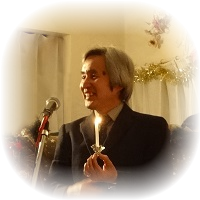
Today, we have missionary candidates visiting from Canada. We heard their testimonies and prayed for them; I hope that we’ll have another opportunity to meet and work together in the future. Since we’ll be having lunch with them today, I’d like to keep my message short and include a little of my own testimony in it.
When I was a junior in college, I was given the opportunity to study abroad in the United States. After studying in Los Angeles for three months, I spent about two months traveling around the U.S. and Canada by bus. I met all kinds of people, but in particular, staying with a Christian family as a homestay guest was an experience that changed my life. As a result, I wanted to have a Christian family of my own. I wanted to learn more about Christianity. I returned to Japan with these desires. After graduating from university, I was recommended by a missionary who took care of me back then to study for about a year at a Christian university in Seattle. My first name, Shoichi, was quite difficult for people there to pronounce, so I decided to add “Peter” as my middle name so that people could call me Peter. The reason I chose this name is that, among the Twelve Apostles, Peter was the one who demonstrated the strongest leadership, and he was also prone to failure. I came to see that Peter was the kind of person who was richly used by God, through God’s help.
As you may know, Peter failed during this incident: when Jesus was arrested and before he was crucified, in the courtyard outside the high priest’s house, a servant girl asked Peter, “Weren’t you with Jesus?” He denied it, replying, “I don’t know what you’re talking about” (Matthew 26:70). Then, when another servant girl questioned him, he denied it again and swore, “I don’t know the man.” And the third time, “he began to call down curses, and he swore to them, ‘I don’t know the man.’ Immediately, a rooster crowed” (verse 74). It was quite a big failure on Peter’s part. The passage continues: “Then Peter remembered the word Jesus had spoken: ‘Before the rooster crows, you will disown me three times.’ And he went outside and wept bitterly” (verse 75).
He should have been able to say, “Yes, I know the man.” Peter’s weakness is shown here: out of fear of other people, he denied knowing him. But despite this weakness, if we look at John chapter 21, the resurrected Jesus met with Peter and healed the wound in his heart. Let’s take a look.
John 21:15 says, “When they had finished eating, Jesus said to Simon Peter, ‘Simon son of John, do you love me more than these?’ ‘Yes, Lord,’ he said, ‘you know that I love you.’ Jesus said, ‘Feed my lambs.’” Here, in response to Jesus’ question, “Do you love me more than these?” Peter makes a confession of faith, “Yes, you know that I love you.” In Greek, when Jesus asks Peter, “Do you love me?” he uses the term agape for love. Peter responds with the word phileo. Agape expresses God’s love—unconditional love. Phileo expresses the brotherly or sisterly love. It’s a love filled with trust and respect, but it’s different from agape. I believe Peter’s choice of the word phileo is shows he is aware of his shortcomings. Jesus repeats the same question “Do you love me?” three times, and the third time, Jesus chooses to use the term phileo. As verse 17 says: “The third time he said to him, ‘Simon son of John, do you love me?’ Peter was hurt because Jesus asked him the third time, ‘Do you love me?’ He said, ‘Lord, you know all things; you know that I love you.’ Jesus said, ‘Feed my sheep.’”
Here, Jesus asked, “Do you phileo me?” Having committed a great failure when he denied Jesus, Peter now conveys his heart: Even if I cannot love you with unconditional love, I want to trust you, to rely on you, to love and follow you with all my heart.” Here, using the words agape and phileo which express different kinds of love, the writer John shows clearly the movements of Peter’s heart. Through this conversation, Peter experiences being accepted by Jesus again and healing in his heart.
I, too, am an imperfect person, but I want to love God with all my heart. With Jesus’ help, I want to walk my path in life. I remember choosing the name Peter with those desires in mind. For a while, I was called “Peter” while studying in the U.S.—it’s now become a fond memory. Now, almost 50 years later, my desire to rely on Jesus—who loves me unconditionally despite my imperfections—and to walk with Him is still the same.
Now, let me turn to Matthew 16:15-18: “‘But what about you?’ he asked. ‘Who do you say I am?’ Simon Peter answered, ‘You are the Messiah, the Son of the living God.’ Jesus replied, ‘Blessed are you, Simon son of Jonah, for this was not revealed to you by flesh and blood, but by my Father in heaven. And I tell you that you are Peter, and on this rock I will build my church, and the gates of Hades will not overcome it.’”
Jesus says, “On this rock I will build my church.” The church is a community that belongs to Jesus Christ. I think that Peter answered Jesus’ question “Who do you say I am?” without much pause: “You are the Messiah, the Son of the living God.” It is upon this confession of faith that Christ builds His church. Jesus loved the imperfect Peter and used him greatly.
Even though we are imperfect, God uses us. I want to trust that he uses us to build his church. I believe you, too, have experienced times where God performed such miracles in your lives. Let us now pray.
(If you can’t hear from the bar above, click the blue button)
iPhone

 日本語
日本語